Take a step back and look at this chart. One widely shared projection has AI software spending alone reaching roughly 8% of US GDP by the end of the decade, before counting the additional AI capital expenditure on data centres and hardware. If it plays out anywhere close to that path, it would be the largest technological investment wave in modern economic history.

Source: @FinanceLancelot on X. Note that the AI figures beyond 2025 are projections, not actuals.
To put that 8% in context, look at what it is standing next to: railroads, electrification, cars, computers and semiconductors. Every one of those wound up as a defining chapter in economic history, and in several cases a defining bubble. AI data centres, AI software and the surrounding buildout have now blown past all of them on this measure.
These historical waves are the closest thing we have to a reference class for how this ends. Railroads overbuilt track nobody needed for decades. The dot-com era overbuilt fibre that took years to “grow into.” Every one of these curves eventually stopped going up and to the right.
The AI buildout is not necessarily following the same script, but it is currently the steepest line on the chart, funded in ways that are, as we will get into next, not exactly reassuring. This combination of unprecedented scale and unusual financing is worth understanding before you decide how exposed you want to be to it.
How It Is Being Financed
Here is where the story gets more uncomfortable. It is one thing to say companies are spending a historic amount on AI. It is another to ask where that money is actually coming from, and the answer, increasingly, is not “cash flow.”
According to the Bank for International Settlements, outstanding private credit extended to AI-related companies has grown from close to zero a few years ago to more than 200 billion dollars, and the BIS estimates it could reach 300 to 600 billion dollars by 2030. Private credit funds originated over 40 billion dollars of loans to AI-related companies in 2025 alone, versus about 3 billion dollars in 2010. The mechanics behind this lending are what should catch your attention.
First, special purpose vehicles are being used to keep debt off balance sheets, meaning some of this leverage is not showing up where you would normally look for it. The BIS itself has warned that some of the financing structures being set up to support AI investment may mask leverage by moving it off balance sheet, and, as they dryly note, leverage does not disappear by being out of sight. Independent research has estimated Big Tech’s off-balance-sheet AI commitments at around 1.65 trillion dollars, with Meta alone accounting for roughly 420 billion dollars, nearly triple its reported debt.
Second, circular financing deals, in which chipmakers, cloud providers and AI labs invest in and lend to each other, are creating a web of interdependency where it is hard to tell whether demand is organic or self-reinforcing.
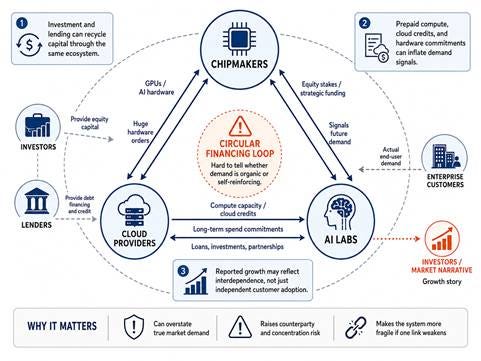
The circular financing loop: capital and demand signals recycling through the same ecosystem.
If any of this sounds familiar, it should. It resembles dot-com era vendor financing, where telecom and tech companies extended credit to their own customers so those customers could buy more of their equipment, inflating demand figures that looked robust right up until they were not.
The freshest example is playing out as this is written. Nvidia is working on a round of AI infrastructure deals potentially worth more than 750 billion dollars, and skeptics warn these arrangements are artificially inflating demand and valuations across the industry. A newly unveiled partnership with SK Group, the parent of memory chipmaker SK Hynix, is alone worth more than 500 billion dollars of business between the two sides. Separately, Nvidia is in talks to provide a financial backstop of up to 250 billion dollars so that OpenAI can lease computing capacity from a planned 10-gigawatt data centre campus in Ohio being developed by SoftBank’s energy subsidiary. The guarantee would cover the lease and construction debt, effectively letting OpenAI borrow against Nvidia’s investment-grade credit rather than its own. And that figure does not even include the chips: Nvidia is separately discussing financing as much as 350 billion dollars of OpenAI’s chip purchases, on top of the 30 billion dollars it has already invested in the company. Nor is Nvidia alone. Google has agreed to backstop lease payments at five data center locations for Anthropic, helping the OpenAI rival obtain what amounts to a 35-billion-dollar loan.
In plain terms: the company selling the chips is now also financing the customers buying them. That is the exact circular pattern flagged above, playing out in real time and at a scale that dwarfs the private credit figures.
None of this means the AI buildout is fake or that the technology does not work. But financing structure matters enormously for how a boom unwinds. Debt funded off balance sheet, and revenue that is partly a company buying from itself, behaves very differently in a downturn than a boom funded by retained earnings. It is the difference between a correction and a chain reaction.
Is the Buildout Actually Paying Off? The Margin Problem
Hundreds of billions are being spent, and hundreds of billions more are being borrowed to spend. The natural next question: is it working? Is this capex translating into broader profitability, or is it concentrated in a very small number of winners?
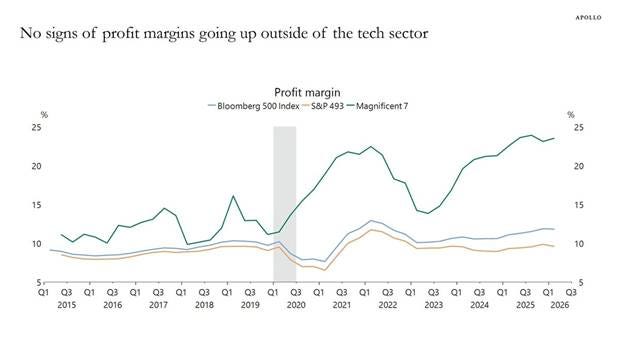
Source: Apollo Global Management.
Profit margins for the Magnificent 7 have expanded sharply. That is the AI trade working exactly as advertised, at least for seven companies.
But look at the other two lines on that chart: the Bloomberg 500 Index and the S&P 493, which is the S&P 500 excluding the Magnificent 7. Both have been essentially flat for years, hovering in the 10 to 12% range with no meaningful upward trend, despite sitting inside an economy that is supposedly undergoing a historic productivity-driven investment boom.
That is the tension worth sitting with. If AI were genuinely lifting corporate profitability broadly, the way electrification or the internet eventually did across entire economies, you would expect margins to drift upward outside of tech too, as companies became more efficient. Instead, the gains are almost entirely contained within a handful of names, while the other roughly 493 companies in the index are, margin-wise, going nowhere.
Margins are only half the picture. Cash flow tells a sharper version of the same story. The Magnificent 7’s combined free cash flow has fallen to its lowest level since early 2024, down to just 7.9% of quarterly sales, only the fourth time in a decade it has dipped below 10%, as AI-driven capex across the group surged 75% year on year to 136.6 billion dollars in a single quarter. Morgan Stanley now estimates that the five largest hyperscalers, Amazon, Alphabet, Meta, Microsoft and Oracle, will spend roughly 805 billion dollars on capex in 2026, up from 261 billion dollars in 2024, with projections of 1.1 trillion dollars for 2027.
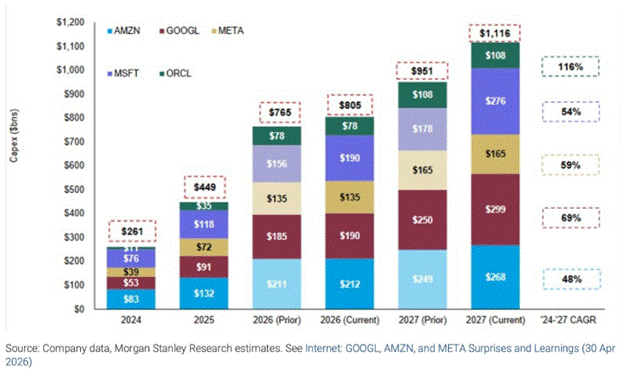
Hyperscaler capex is on track to roughly triple between 2024 and 2026.
The buildout is forcing real behavioural change. Alphabet and Meta have halted share buybacks, while Apple and Microsoft have scaled theirs back, as the group shifts from an asset-light model to a capital-intensive one. The strain is now visible in the accounts themselves: Alphabet, long viewed as a money-printing machine, turned free cash flow negative in the second quarter of 2026 for the first time, while its long-term debt more than doubled to 98 billion dollars over the first half of the year. Amazon’s long-term debt jumped 81% to 119 billion dollars in the first quarter alone.
The other 493 companies are not seeing anything like this cash compression, simply because they are not the ones funding trillion-dollar AI infrastructure. So, margins for the Magnificent 7 look intact on paper, while the cash behind those margins is increasingly getting plowed straight back into capex, and increasingly topped up with debt.
It might just mean we are early. But it does mean the current re-rating of markets is resting on the performance of a very narrow group of companies.
The Hidden Systemic Risk
Alicia Levine, Chief Investment Officer at BNY Wealth, made an observation recently that deserves more attention than it received. The claim, in short: AI has quietly become the single dominant factor sitting across nearly every corner of a supposedly diversified portfolio. Layer by layer, here is what that looks like.
Equities. Roughly 20% of the S&P 500 is driving the earnings growth of the entire rest of the index, and that slice is effectively just six companies.
Credit. Hyperscalers are increasingly funding their capex through debt rather than cash flow, which means AI exposure isn’t confined to equities anymore.
Emerging markets. South Korea and Taiwan together now make up close to 50% of the EM index, and both economies are deeply tied to AI semiconductor production. At that point, the “EM benchmark” is an AI supply chain index wearing an EM label.
A portfolio holding US equities, US credit and EM equities, which looks diversified on paper, may actually be making one concentrated bet three different ways.
A Final Thought
There is a useful, humbling parallel here in something bigger than markets: even genuinely transformative infrastructure does not always pay back the people who financed it. The Panama Canal bankrupted its first builders, the French company whose 1889 collapse wiped out hundreds of thousands of shareholders, before the US government finished the job, and to this day it is unclear whether the canal has earned back its construction cost in real terms, despite being one of the most strategically valuable pieces of infrastructure on the planet. Railroads and fibre optic networks tell a similar story: overbuilt, over competed and financially brutal for the original shareholders, even as the assets themselves went on to quietly underpin the next century of commerce and communication. Most of us are, in some fashion, beneficiaries of 19th and 20th century malinvestment we never paid for.
That is the distinction worth holding onto as the AI buildout continues: whether the technology succeeds and whether today’s capital gets repaid are two separate questions. History suggests it is entirely possible for the answer to be yes to the first and no to the second, with the eventual winners being adjacent suppliers and disciplined capital allocators, not necessarily the companies and financiers funding the buildout at today’s prices.
Disclaimer
This publication is for informational purposes only and does not constitute investment advice, an offer or a solicitation to buy or sell any security or fund. Figures are drawn from public sources believed to be reliable as of July 2026, including the Bank for International Settlements, MSCI, Morgan Stanley estimates, Apollo Global Management and press reports, but are not guaranteed for accuracy or completeness. Certain figures, including announced partnership values and financing arrangements under negotiation, are based on media reports and may change. Past performance is not indicative of future results.