The views set out in this article were expressed on 18 August 2026. All market data, price levels, and positioning references are as of that date and have not been revised for developments occurring after it. The article contains clickable links to earlier commentary in which these themes were previously articulated.
The Korean market was up more than 120 per cent at one point this year. It then fell roughly a third from its June peak in a matter of weeks, erasing something close to two trillion dollars of value, with the exchange tripping circuit breakers at a pace that has already exceeded 2008. By the middle of August, it had rallied more than 20 per cent off its July low and was back in bull market territory. Same index, same two companies driving half of it, same calendar year.
That is not a market discovering value. That is capital arriving and leaving.
The most instructive casualty was not a retail account in Seoul. Jane Street lost roughly $15 billion in July, its first losing month in about a decade. The loss did not come from market making. It came from a large stake in an artificial intelligence hedge fund that had returned 439 per cent net in the first half of the year, and from directional positions in Asian equities. When that fund met its margin calls, its assets fell from a peak near $45 billion to around $10 billion in days, with most of its public book sold to Citadel at a discount. I have no view on any of the businesses involved. They may all be excellent. My point is narrower and I think more useful. The most sophisticated participants in the market were standing in the same place as everybody else, and the exit was the same door.
Why this keeps happening
I call this a rolling bubble. When you put this much money into the system it does not spread evenly. It concentrates. It picks one asset class, saturates it, and then leaves.
What has changed is the speed. Fifteen years ago, sitting inside an institution, I had information ahead of the average participant. Today you, I and everybody on social media receive the same information at the same moment. An asset that ought to reprice over three or five years on a change in outlook now reprices in eight weeks. You get a two-year return in two months, the asset is fully priced, everybody becomes bored of it, and the money goes looking for the next thing.
I got this wrong in my own way this year. We bought oil in November and December on the view that the next rotation would be into energy. It was not. It went into semiconductors, into Taiwan and Korea, into everybody’s favourite trade. I could see the Korean rally forming and I did not participate, because I could not underwrite it. That is a real cost and I will not pretend otherwise. But the rule is simple. If I cannot explain why something is working, I do not own it. Every year there will be a stretch of two or three months where that rule costs me money, and I accept it.
The cruelty of the cycle is not in the drawdown. It is in the sequencing. That fund is still up sharply for the year. Most of the people invested in it are not, because most of them arrived after the spring. That is recency bias doing its work. Allocators look at the last three months of performance and hand money to whoever participated most aggressively in the bubble that has just matured. To fund those allocations, they sell what has not participated. So, capital leaves the cheap thing to buy the expensive thing, and the fear of missing out closes the loop. I would rather be early and uncomfortable for a quarter than late and correct for a week.
ON THE RECORD, JANUARY 2026
In my Global Macro Outlook for 2026, presented to the CFA Societies in Bombay and Kolkata, I argued that the baton was passing from equities to commodities, that commodity equities and currencies would outperform G7 equities and currencies, and that electrification and nuclear energy were setting up for a large move on the back of government policy. I also said gold could reach $5,000 and silver $100 to $120 before pulling back sharply. Gold went on to peak above $5,400 in late January.
Global Macro Outlook 2026, Pinetree Macro, 7 January 2026
The machine underneath
None of this is an accident of sentiment. Since 2020 the world has been running on a different operating system, and almost nothing has changed it back.
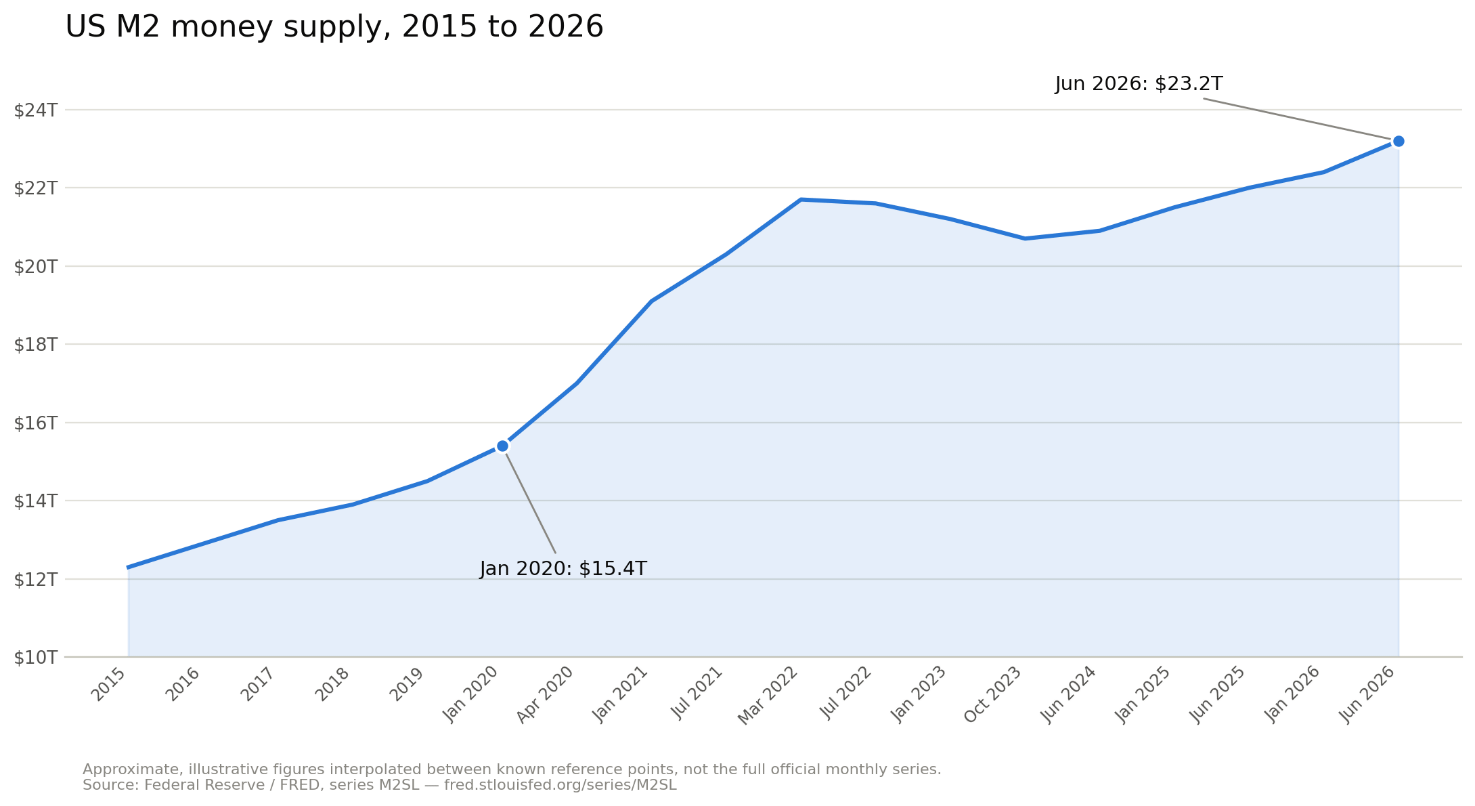
Start with the money. US M2 now stands near $23 trillion, more than 50% above its level at the beginning of 2020. Put differently, roughly one-third of the money stock that exists today has been added over the past six years. And those dollars were not printed in any innocent sense. They were borrowed into existence and absorbed onto central bank balance sheets.
Three things follow from that, and they are the whole framework.
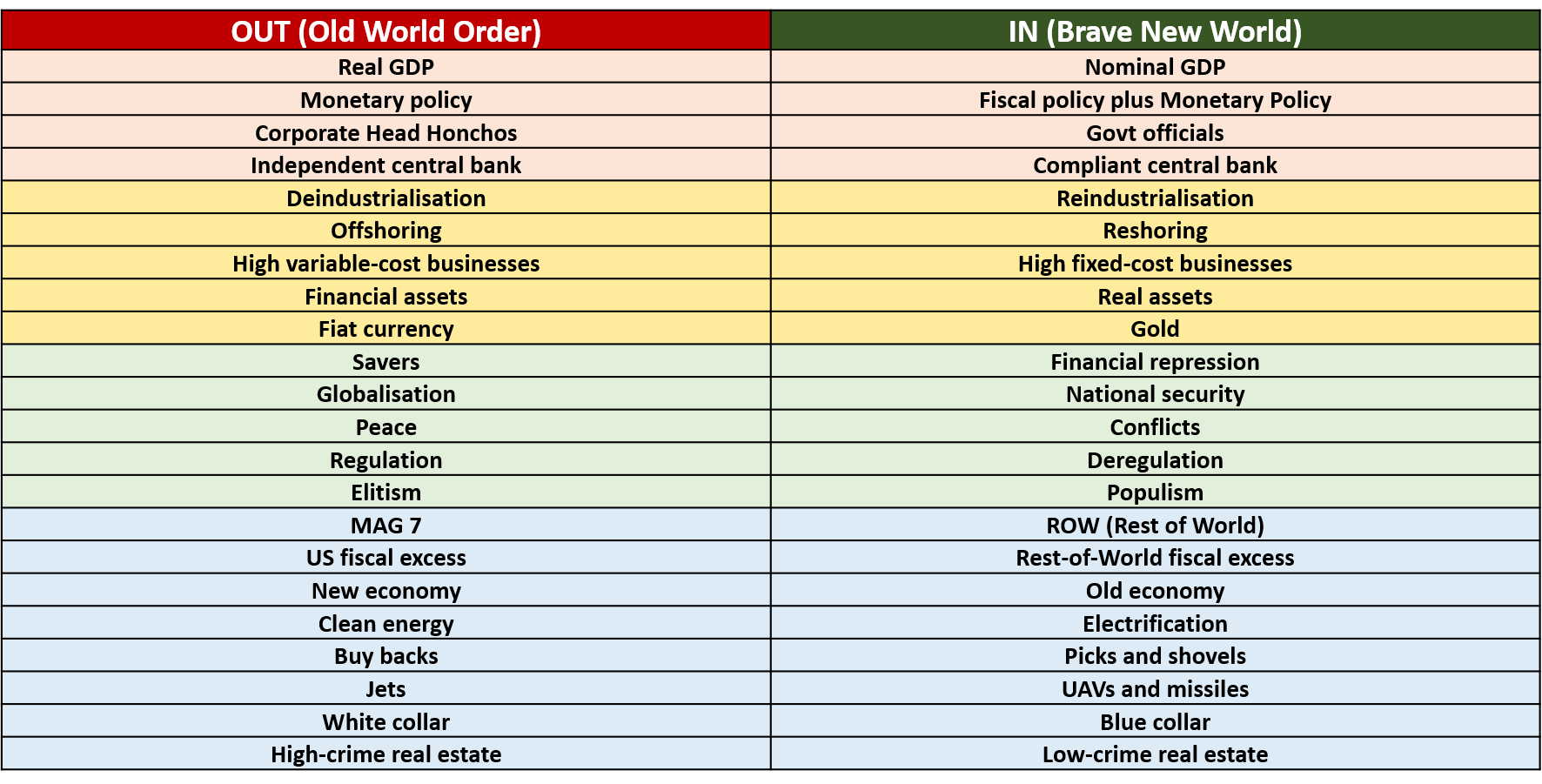
The first is that nominal GDP is becoming increasingly important, not just real GDP. Look at India. Nominal GDP growth was unusually weak last fiscal year, largely because of an exceptionally low GDP deflator, even as real activity remained strong. Inflation has since started to normalise, reaching 4.45 per cent in July, the second consecutive month above the RBI’s 4 per cent target. My own view, and it is a view rather than something anyone can verify today, is that the new normal for Indian inflation could be 5 to 6 per cent rather than the 3 to 5 per cent range we grew used to, and that the United States could settle at 3 to 4 per cent rather than below 2 per cent. The implication is straightforward: own the assets that work in a nominal world.
The second is that fiscal policy has replaced monetary policy as the thing worth watching. The single most market-moving document of this summer was a photograph of a notepad. At Camp David on 31 July it read, under the heading “To Do”, buy Japanese yen, five to ten billion dollars. Washington then intervened alongside Tokyo, with the New York Fed selling euros to buy yen on behalf of the US Treasury, after the currency touched levels last seen in the 1980s. That is where power increasingly sits. Meanwhile, US federal debt has crossed $40 trillion, net interest costs are expected to exceed $1 trillion this fiscal year, and government expenditure represents roughly 40 per cent of US GDP, more than half of French GDP and around 30 per cent of India’s. Stop reading chief executives. Read ministers.
The third follows from the first two. If debt is the binding constraint, the only politically survivable exit is to reduce the value of the money. Not default, not austerity. Debasement. From Rome to the present there has only ever been one route, and every government that promises two thousand rupees here and fifty thousand there is quietly choosing it.
ON THE RECORD, MARCH 2026
This is not a new argument for us. In March I set out why the debt itself is the entire story. US debt has risen sixfold in twenty-five years while GDP has risen threefold, and of the fifty-two countries over the past two centuries that reached 130 per cent debt to GDP, fifty-one defaulted within fifteen years through devaluation, inflation or restructuring. The United States crossed that level in 2022.
The conclusion I drew then is the one I would still draw today. The question is not whether governments default, but what form the default takes. Once you answer that, the portfolio writes itself. Long duration bonds in Western currencies are, in a regime of fiscal dominance, a wealth destruction strategy.
Nothing Stops This Train, Pinetree Macro, 17 March 2026
This is why the framework I use has not changed in three years and will not change unless there is a fundamental shift. Financial assets to real assets. Fiat to gold. Globalisation to national security. Peace, unfortunately, to conflict. Deindustrialisation to reindustrialisation. Clean energy to electrification. White collar to blue collar. Buybacks to bond issuance.
That last one deserves a number, because the shift is not subtle. Between 2013 and 2022, mega-cap technology was largely retiring its own equity. That era has ended. The largest hyperscalers had already issued close to $200 billion of investment-grade debt by mid-year and Goldman Sachs expects issuance to reach around $250 billion in 2026, while total global artificial intelligence-related issuance is forecast near $570 billion. Ask the question plainly. Would you rather own a company buying back its stock, or one issuing debt at materially higher financing costs to fund a capital expenditure race it cannot afford to lose?
And reindustrialisation carries a second order consequence that I think is badly under-priced. A service economy runs on low grade electricity. A manufacturing economy runs on high grade electricity. Manufacturing is around 13 - 14 per cent of Indian GDP and roughly a tenth of American GDP, and every government in the developed world wants that number higher. I do not need a view on which model wins the artificial intelligence race in order to own the grid that all of them require. Our exposure to the whole theme sits at ten to fifteen per cent of the book and it is entirely second and third order. Infrastructure, power, industrial inputs. If I could buy an electrician, I would.
ON THE RECORD, FEBRUARY 2026
I have never invested in the artificial intelligence boom directly. I look at all of it through picks and shovels. I do not care which model wins, because every one of them has to spend on compute, and every unit of compute needs copper, uranium and a functioning grid. The Ford chief executive said publicly that he has thousands of six figure electrician roles he cannot fill. The same shortage exists in India, with the added complication of our attitude to blue collar work.
Electrification has been my macro theme of the decade, and artificial intelligence has simply accelerated it.
Picks and shovels, not the gold rush. Ritesh Jain on X
On gold, watch Beijing rather than Washington
We cut our gold weighting hard in February, to around 3 per cent, when the liquidity impulse out of China stalled. The metal then fell from roughly $5,400 in January to near $4,000 by June, its worst quarterly decline in thirteen years. As the impulse resumed, we rebuilt our position, and gold was back near $4,400 by the middle of August.
The People’s Bank of China has now added gold for twenty-one consecutive months. July’s purchase of about 20 tonnes was its largest single month since October 2023, lifting official holdings to 2,366 tonnes, which is still only around 8 per cent of its reserves against roughly 70 per cent for the United States. The private flow is louder still. Chinese net gold imports hit 152 tonnes in June, the highest since March 2024, with first half imports up 138 per cent.
Here is why I think it continues. China is fighting deflation. Property is finished as a wealth vehicle for the Chinese household, prices have kept falling, and Beijing has spent more than a decade encouraging gold into household hands. If liquidity keeps flowing and gold keeps rising, the household balance sheet repairs itself, and a nation of savers might finally start spending. That is the only genuine imbalance left in the world economy, and gold appears to be the instrument Beijing has chosen to fix it.
ON THE RECORD, 26 MARCH 2026
I made this argument five months ago and it applies to India as much as to China. If Indian households keep buying gold, the rupee can depreciate considerably further against the dollar, and I do not think that is bad news. Look at it correctly and Indian households are short the rupee and long gold. China is doing the same thing deliberately by encouraging its citizens into the metal, with the difference that a large current account surplus means the renminbi is not under the same pressure as the rupee.
In January I also noted that the value of gold held by Indian households had come to exceed the entire market capitalisation of Indian equities. Urban India financialised. Rural India never stopped owning the metal.
Indians are short the rupee and long gold. Ritesh Jain on X
The corollary is uncomfortable for anybody holding currency. Every major economy faces the same arithmetic, and gold supply cannot be legislated. The question I am asked most often is whether one should wait for the rupee to recover before investing abroad. Consider what you are waiting for. Subsidies are rising across the political spectrum in every country I look at, and I have no political view on any of it, but the promises are denominated in currency and there is only one way to fund them. The rupee touched a record 96.84 to the dollar in May. Waiting for appreciation is not a strategy.
One qualifier that usually gets lost. Gold is not the only asset that does this job. In every genuine debasement, Venezuela, Zimbabwe, Argentina, the money that cannot buy gold buys the index instead. Good businesses preserve purchasing power too. The point is ownership, not the instrument.
Leverage, and the November clock
I have called leverage a destroyer of wealth and the numbers justify the concern. Margin debt in the United States hit a record $1.53 trillion in June, up more than 50 per cent year on year, and sits close to its highest ever level relative to the money supply. That is a great deal of borrowed money standing behind a narrow rally.
But I do not think it breaks before November. America is among the most leveraged large economies and the most consumption-dependent, and its political calendar runs straight through the asset market. A fall of fifteen or twenty per cent into the midterms would be politically damaging for the incumbent party, and everybody in Washington understands what follows from that. So, the political incentive to cushion corrections will be unusually strong. Around $166 billion is expected to be returned to American importers through tariff refunds, while unusually large tax refunds have also supported household finances and consumption. That support is now beginning to fade, and I expect the economy to weaken from the fourth quarter. Just as we learned to think in terms of before and after COVID, I am now thinking in terms of before and after the midterms.
ON THE RECORD, NOVEMBER 2025
I have written before that a rising stock market is now a matter of national security for the United States. That is not a figure of speech. The Treasury has become acutely dependent on short term funding from leveraged buyers, it rolls over trillions of dollars of debt every quarter into an increasingly sceptical market, and the share of purchases coming from stable lenders such as foreign central banks and sovereign wealth funds has been drying up. A government in that position cannot afford a disorderly equity market, and it will not permit one voluntarily.
The one thing that has arrived earlier than I expected is the bond market. Long yields have been rising, the thirty year sits near a nineteen year high, and the Treasury market is plainly unhappy about deficits and about the scale of artificial intelligence borrowing. I do not think it collapses. It can correct. Equally, a new round number on the American indices in the next few months would not surprise me at all, given how close they already are and how much money is standing behind that outcome.
So yes, I think a correction is coming, and it could be ten per cent or more. Should you wait for it? Only if your horizon is measured in months rather than years. Our structure is designed to capture most of the upside and considerably less of the downside, and the cash we carry is what makes that possible.
Underneath all of this sits one number, and it is rising for everybody: the cost of capital. If the ten-year yield rises, price-to-earnings multiples have to compress. That is arithmetic, not opinion. The squeeze arrives quietly, through refinancing rather than through any single event. Around two thirds of investment-grade debt maturing between now and 2028 carries an interest rate of four per cent or less, and much of it will need to be refinanced at today’s higher rates. Nowhere is this clearer than among the hyperscalers, which have gone from being some of the most cash-generative businesses in the world to some of the largest borrowers in the investment-grade market, on track to rival the major banks as issuers. Alphabet’s free cash flow turned negative in the second quarter for the first time since it listed in 2004, while aggregate hyperscaler capital spending is on pace to overtake operating cash flow this year. The AI infrastructure build-out is therefore creating enormous new demand for capital at precisely the point when that capital is becoming more expensive.
The same pressure applies to the sovereign. Foreign investors hold roughly thirty per cent of outstanding Treasuries, and the official share has fallen steadily as central banks have increased their allocation to gold. The reshoring trend adds another dimension. If countries increasingly seek to rebuild domestic manufacturing capacity and reduce their dependence on foreign supply chains, the global economy becomes more capital-intensive, requiring more investment in factories, infrastructure and energy. And if reshoring materially reduces the US trade deficit, it could also narrow one of the channels through which foreign savings are recycled into US financial assets, even as the government’s borrowing requirement remains elevated.
The conclusion follows without much difficulty. When capital becomes more expensive, companies that can fund their own growth become more valuable relative to those that must continually return to the market for financing. That is why our attention has been moving away from the crowded, capital-intensive end of the market, semiconductors included, and toward businesses with low reinvestment requirements and genuine free cash flow. It is the same instinct that governs the cash we hold. The purpose of cash is not simply to be defensive. It is to preserve optionality, so that when an asset becomes cheaper, we have the capital to buy it.
Japan is not fragile, but it is the transmission mechanism
Japan has one of the strongest external balance sheets in the world, with net foreign assets equivalent to around 85 per cent of GDP. The United States sits on the other side of that ledger, with a net international investment position of roughly minus $21 trillion, or around 68 per cent of GDP.
The risk Japan poses is therefore not to itself. It is to everybody else. Japanese investors are the largest foreign holders of US Treasuries, with around $1.1 trillion. Domestic yields have finally moved: the ten-year is near 2.9 per cent, the highest since 1996, and the thirty-year is above 4 per cent, on a mixture of inflation concerns, fiscal pressure and expectations that the Bank of Japan tightens again. Japanese investors sold roughly $30 billion of US bonds in the first quarter alone. Repatriation is not a hypothetical scenario. It has started. That is one reason the yen matters so much to Washington, and it is why I read every move in Japanese yields as a question about what happens to bond markets everywhere else, including India’s.
ON THE RECORD, 5 AUGUST 2026
Two weeks ago, I wrote that the headlines on Japan were getting this backwards. The yen was under pressure because inflation was rising while the Bank of Japan remained too scared of its deflationary scars to raise rates far enough to stabilise the currency. After what the US Treasury did that week, Japan does not need to sell dollar bonds, and Washington may end up buying long dated Japanese government bonds with the yen it accumulated through intervention. You scratch my back and I scratch yours.
The conclusion I drew was blunt and I stand by it. Cash is going to be trash, savers will be punished for saving, and there is a reason every risk asset is breaking out at once.
For that reason, our rest of world exposure is deliberately unhedged. There is essentially one liquid currency hedged vehicle available and we moved out of it when the yen crossed 160. We are bullish Japanese equities. And if I could buy a thirty-year Japanese government bond near 4 per cent through a listed vehicle I would, because at similar yields I would rather lend to the world’s largest creditor than to the world’s largest debtor.
Japan is also now the cheapest developed country in the world to visit. A dinner in Tokyo costs a fraction of a dinner in New York. That is not a travel tip. It is a valuation signal.
The oil trade this year was not oil
I cannot get a clean read on crude. The gold to oil ratio has traded at ten and it has traded at a hundred, and today it sits somewhere in the middle. Over time, if gold becomes a formal part of the monetary system again, I expect it to keep outperforming oil. That is a decade view, not a trade.
The trade this year has been refining. Ukrainian drones have taken Russian refining capacity offline, Persian Gulf product exports are down roughly 80 per cent year on year against about 48 per cent for crude, and the industry has lost several million barrels a day of capacity to closures and war damage. The result is that the US diesel crack spread reached an all-time high of about $102 a barrel in the middle of August and settled in triple digits for the first time, while Brent traded around $90 and WTI in the mid-eighties. Read that again. The margin on refining a barrel briefly exceeded the price of the barrel itself. You do not consume crude. You consume product. That is where the money has been, and it is the part of the energy complex we own.
Real assets do not mean real estate
This is the correction I find myself making most often. When people reach for real assets, they usually buy an index, and most real asset indices carry a heavy property weighting. I would not touch developed market real estate at all.
The West’s love affair with immigration is over, and immigration was the demand engine. Canadian, Australian and New Zealand housing are all under real pressure and American housing is soft. Underneath that sits a generational affordability problem that does not resolve on any policy timeline I can see. A record 25 million American adults under thirty-five were living with a parent last year, roughly one in three. In Canada the share of millennials under thirty living at home is around 31 per cent, close to double the boomer generation at the same age. Every one of those young adults is a household that has not formed.
India has become a bottom-up market
Do not look at India through the index. The Nifty has essentially gone nowhere over two years, sitting near 24,200 against peaks above 26,300 in September 2024 and again in January 2026. Over that same period, electrification names have been six to ten baggers. The benchmark does not contain tomorrow’s leaders. Twenty or thirty per cent of it does, and a great deal of the rest is consumption, including the banks, which are consumption businesses wearing a financial label. Look at the small caps that have listed in the last few months and you will find companies with a pedigree you did not know existed here.
ON THE RECORD, 27 APRIL 2026
I put this bluntly in April. Engineering, electrification, defence and the energy transition, to which I would add mobility as a service and the blue-collar worker. Indian benchmarks may have delivered nothing, but look at what those sectors did over the same period. Indian benchmarks do not contain tomorrow’s winners, so stop looking at them for the answer.
There are two India stories worth owning and they are not the same story.
The first is China plus one, which is real but bounded. It applies to work that a three-thousand-dollar per capita economy should be doing and that a ten-thousand-dollar per capita economy with an ageing population no longer wants. Toy manufacturing, handset assembly, low complexity work. It comes to India rather than Vietnam or the Philippines because the customer also wants access to the domestic market.
The second is more interesting and considerably larger. High end engineering, defence, electrification and, in my view, wealth management. India has concluded nine trade agreements covering thirty-eight countries since 2021, including the European Union deal signed in January and the United Kingdom agreement that came into force in July. On defence, NATO members committed at The Hague to five per cent of GDP by 2035, while European allies and Canada spent more than $574 billion on defence in 2025 in real terms. Japan has also moved to a multiyear defence build-up programme and increasingly uses multiyear procurement, which changes how a subcontractor is valued the second time it wins an order rather than the first.
ON THE RECORD, JUNE 2024
The defence super cycle was a pure macro call and I made it six months before the last US presidential inauguration. My argument then was that an America First administration would accelerate deglobalisation, that the American military umbrella would no longer be freely available, and that every country would therefore be forced to fund its own security. I said at the time it would have played out the same way under either candidate.
Global military spending has since hit a record of roughly $2.7 trillion. Every country that relied on the American umbrella is now writing cheques. European, Japanese, Korean and Indian defence are decade long compounders.
Pinned post, Ritesh Jain on X, 28 June 2024
Our own defence exposure is European rather than American, where I find the primes bloated and the governance increasingly difficult to read. I would flag honestly that 2026 has been a year of consolidation for European defence after a very powerful multiyear run, with the sector broadly flat and investors becoming far more selective. The spending trajectory has not changed. But you are buying a rerated sector, not a cheap one, and it is worth saying so.
On electrification the arithmetic is simple. Indian data centre capacity is set to grow from roughly 1.5 gigawatts to somewhere between four and seven gigawatts by 2030, and the country still accounts for only three to four per cent of global capacity while generating close to a fifth of the world’s data. Where do you think the electricians go? If you have a reliable one in your building today, I would not count on having him in a year. That is already the story across the West and it is coming here.
Wealth management deserves a separate word because it sits at the intersection of regulation and product. I do not like heavily regulated businesses. Wherever the regulator can reach, multiples compress. A bank needs capital adequacy. A mutual fund is captive to its benchmark and to protective rules written, quite rightly, for the investor with five thousand rupees. Wealth management needs almost no capital and can carry the entire shelf, both assets and liabilities. The range of product available in North America is vastly wider than what an Indian adviser can offer today, and Indian policymakers tend to borrow the Western template eventually. Peer to peer lending will go through its painful adolescence here, but a refined version in two or three years lets a client earn a monthly yield rather than accept a savings rate. That is a structurally better earnings pool than banking or asset management.
Beyond gold
Copper has broken out to all-time highs, with the London cash contract pricing above $14,800 a tonne and the American contract setting a record in August, up close to fifty per cent year on year. This is no longer just the old copper story about Chinese construction. Supply growth has been repeatedly downgraded as disruptions hit major mines, while grid investment, data centres and electrification are adding to structural demand. Tightening supply against rising demand is the cleanest setup in commodities right now.
I would also start looking at platinum. It traded at parity with gold as recently as the middle of the last decade and now sits at roughly 40 per cent of the gold price, at a time when supply is tightening. If gold becomes genuinely unaffordable for the ordinary buyer, jewellery demand has to migrate somewhere. We also hold uranium, which we believe is finally through its consolidation, though there is still no clean way for an Indian investor to access it.
What it adds up to
The bubble is deflating rather than bursting, and another one is already forming somewhere. That is simply what a world holding this much borrowed money does.
What you cannot be is a saver. Saving worked before 2020. It does not work when the value of money is being deliberately eroded to fund promises that cannot otherwise be kept. The rational response is to own assets, and to prefer the ones with something real underneath them. Metal, capacity, grid, sunk cost in the ground.
And the risks are rising, not falling. Long yields are revolting earlier than I expected, energy is hostage to a conflict nobody controls, and it takes very little for a bond market to become disorderly, as the United Kingdom discovered in 2022 when a sharp repricing in long-dated gilts triggered forced selling by liability-driven investment funds and a self-reinforcing fire-sale dynamic, forcing the Bank of England to intervene to restore market functioning. I do not expect a repeat. But it is my job to stay on top of that risk rather than to assume it away, and that, in the end, is what the cash is for.
Disclaimer
The views set out in this article were formed and expressed on 18 August 2026. All market data, price levels, positioning and statistics referenced are as at that date and have not been revised for developments occurring after it. Markets move quickly, and readers should not assume that any view, allocation or figure described here remains current at the time of reading.
This article reflects the personal views and opinions of the author and is provided for informational and educational purposes only. It does not constitute investment advice, a recommendation, or an offer or solicitation to buy or sell any security or financial instrument. Any reference to specific securities, sectors, instruments or markets is illustrative of the author’s macroeconomic framework and should not be read as a recommendation to transact.
AI tools were used in the preparation of this article as an editorial aid and refinement of language. The views, analysis and conclusions expressed are those of the author.
Links to earlier commentary are included as a record of previously published views and are not a representation that those views were, are or will prove correct. Investing involves risk, including the possible loss of principal. Past performance is not indicative of future results. Readers should conduct their own analysis and consult a qualified financial adviser before making any investment decision.