Why We Created the Canopy
A pine tree’s canopy sits at the very top, where you can see the whole forest rather than a single tree. That is the idea behind this publication, and behind how we invest.
Every day, investors are flooded with headlines, price moves, and opinions. Most of it is noise. What actually builds or protects wealth over the years is understanding a small number of big forces: where money is flowing, how the major economies are changing, and which long-term themes are just beginning while others are quietly ending. That is what global macro investing means, and it is the lens we use at Pinetree Macro.
The Canopy is our monthly attempt to share that view in plain language. Each edition follows the same simple structure, which also happens to spell out its name:
Cross-Assets: what happened across stocks, bonds, and commodities this month, and what it tells us. Narratives: the big stories reshaping the world economy. Opportunities: specific themes where we see long-term value. Year Ahead: how we are thinking about the next twelve months and beyond.
We close each edition with our recent publications and a quote worth reflecting on.
01 / Cross-Assets
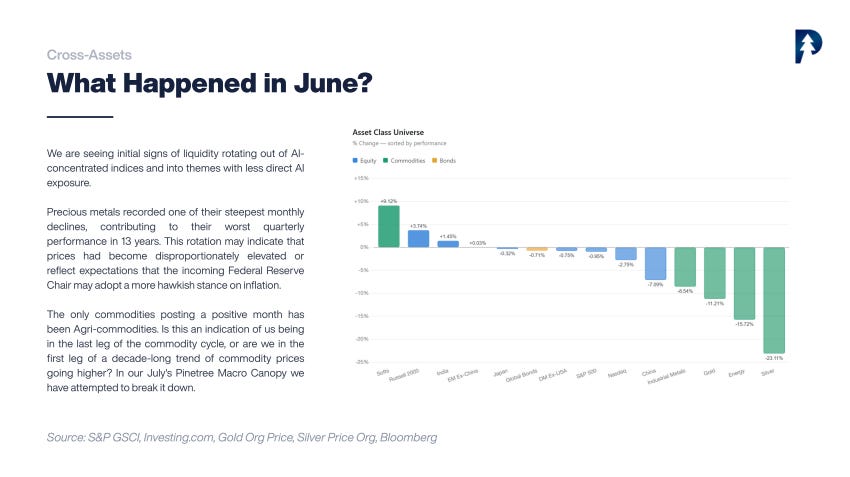
When something falls this hard, the most useful question is not “how much?” but “who is selling?”
In gold’s case, the selling came mostly from traders: futures contracts and gold funds being unwound after a spectacular run-up. Meanwhile, the world’s central banks, who buy gold as a long-term reserve rather than a trade, continued purchasing right through the decline. Demand for physical gold bars stayed strong too. When short-term money sells and long-term money keeps buying, the fall usually says more about crowded positioning than about the metal itself.
There is a historical warning worth respecting. The last time gold had a quarter this bad was 2013, and that marked the start of a long bear market. The difference today is that steady central bank buying did not exist back then at anything like this scale. Our view: the 2013 comparison may hold for a few months, but we doubt it holds for a few years.
One more observation. The only commodities that rose in June were agricultural, and that strength came from supply constraints, weather and rising input costs, not from booming demand. It is a different kind of signal, and worth keeping separate in your mind.
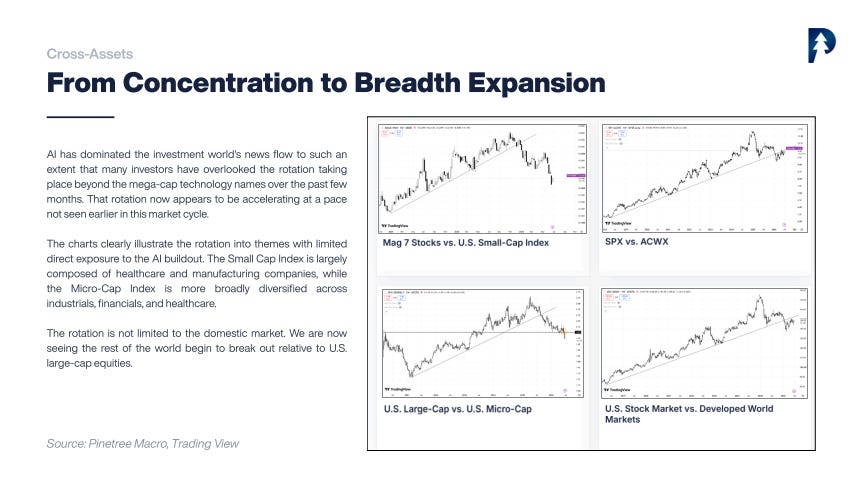
For years, the biggest technology companies grew their profits so much faster than everyone else that their high valuations seemed fair. That profit gap is now narrowing, partly because building AI infrastructure is consuming enormous amounts of their cash. As the profit gap closes, the valuation gap becomes harder to justify, and money naturally begins looking elsewhere: at smaller companies, at healthcare and manufacturing, and at markets outside the United States.
A word of caution: we have seen false starts in this rotation before. What would convince us it is real is not just share prices moving, but profit forecasts for smaller companies actually being raised.
If you own a standard index fund, most of your money is in those few big companies. That is a bet on concentration continuing, whether you meant to make it or not. Knowing that is the first step to deciding if you are comfortable with it.
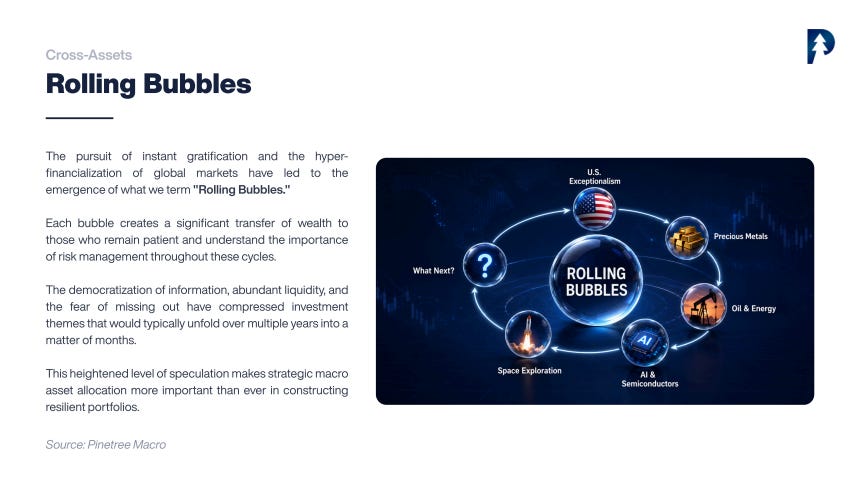
Investment themes that once took five years to play out now play out in five months. More money trades automatically, information spreads instantly, and everyone watches the same charts. We do not expect this to reverse, so we gave it a name: rolling bubbles. One theme inflates, deflates, and the money rolls into the next.
What does an ordinary investor do with this? Something simple but genuinely hard: decide your selling plan before you buy. How big should the position be? What would make you trim it? Answering these questions in advance, and rebalancing on a schedule rather than on emotion, sounds boring. But in markets that move this fast, boring rules beat good instincts.
02 / Narratives
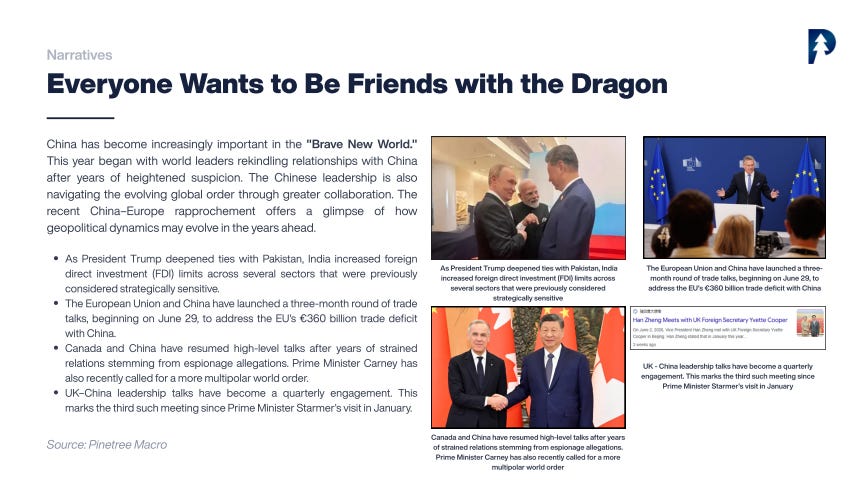
We would not mistake this re-engagement for friendship. What actually came out of the Brussels talks was a process: defined topics, a monitoring mechanism, and an October deadline for visible progress. Beijing has made clear it can live with failure.
The investment point is that a world which re-engages cautiously still keeps its hedges on. Countries continue building duplicate supply chains, holding larger inventories, and spending more on defence, even while trade ministers shake hands. All of that costs money, and those costs eventually show up in inflation and interest rates staying higher than the last decade taught us to expect.
Watch October. Progress would be good news for European industry. A breakdown would put Europe’s new trade defences into use, and markets have not really priced what that would mean.
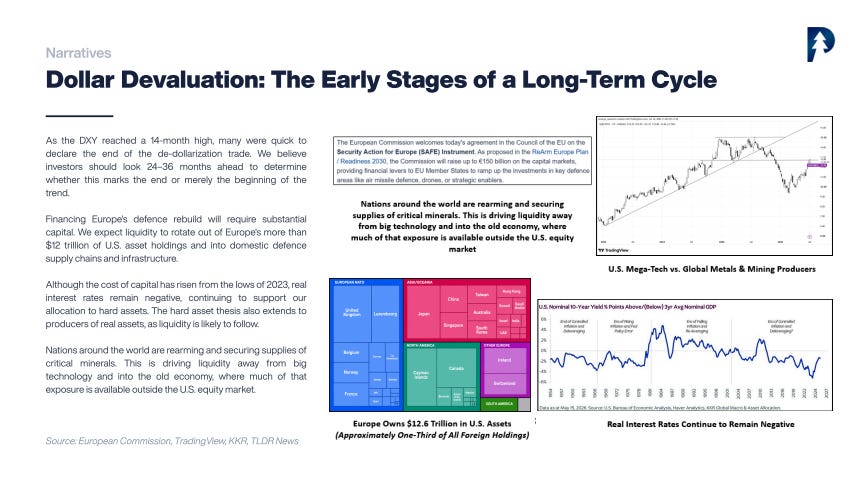
The dollar index recently touched a fourteen-month high. Many took this as proof that the world’s move away from the dollar is over. We think that confuses two different things.
The dollar’s price moves month to month with interest rates. The bigger question is about demand for dollar assets over many years, and there the direction has not changed. Central banks keep diversifying their reserves, and they keep buying gold precisely because gold is nobody’s debt.
Two slow-moving forces deserve attention. Foreign institutions do not need to sell American assets to weaken the dollar. They only need to protect, or “hedge,” more of their existing holdings against currency swings, and those protection levels are still unusually low after a decade of dollar strength.
03 / Opportunities
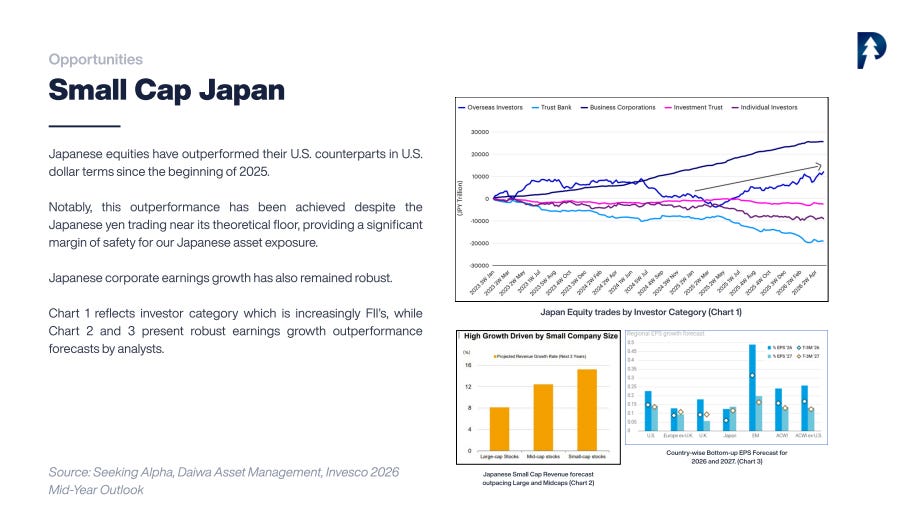
The most important part of the Japan story does not appear on any chart. It is about corporate behaviour. For decades, Japanese companies hoarded cash and paid little attention to their shareholders. Years of steady pressure from the stock exchange and from investors have changed that: companies are returning cash, selling stakes they held in each other, and taking their share prices seriously.
The large companies that foreign investors buy easily have already been rewarded for this change. The smaller companies, where the bargains were biggest and hardly any analysts pay attention, are much earlier in the process. That is the opportunity.
There is a domestic angle too. Japanese households hold enormous savings in accounts that earned nothing for a generation. With interest rates and inflation finally positive, they have both a reason and a pressure to move some of that money into investments. That flow has barely begun.
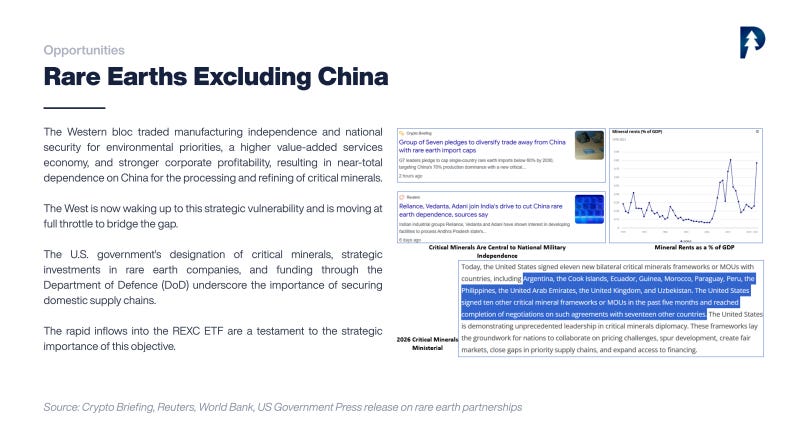
The West has tried to rebuild this industry before, and it failed every time for the same reason: price. Whenever new producers appeared, supply from China rose, prices fell, and the new projects went under. Investors remember this well.
What could make this attempt different is not enthusiasm but structure. Governments are now taking direct stakes, guaranteeing minimum prices, and signing long-term purchase agreements. A project with those protections can survive a price war. A project with a press release and a stock ticker cannot. That is the test we apply to everything in this space.
We would also point out that the bottleneck is not mining but processing and separation. That is where the pricing power will sit, and it is where we focus.
04 / Year Ahead
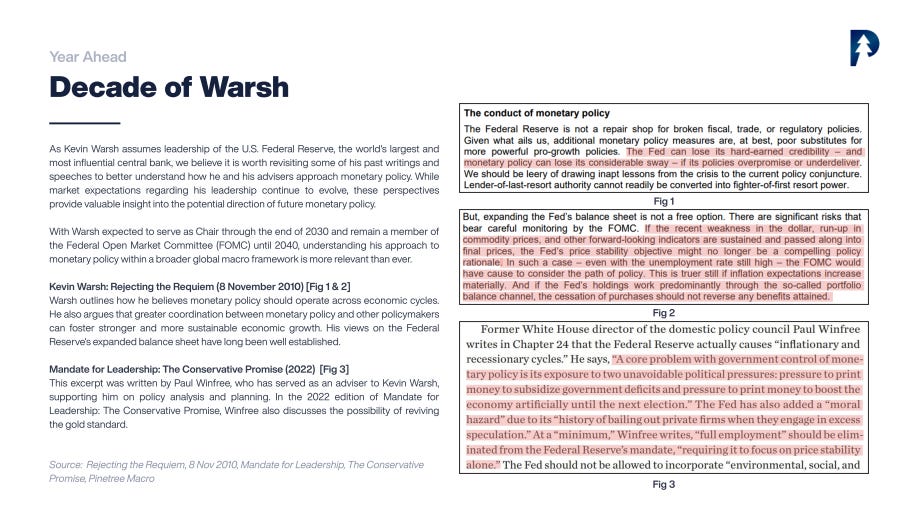
The confirmation vote was the closest for any Fed chair in modern history, which tells you the job itself has become political ground. There is also an irony here: a chair nominated by a president who wants lower rates has arrived just as the market has started to price hikes. How he handles that tension early on will tell us a great deal.
For portfolios, the practical question is how quickly the Fed comes to the rescue in the next downturn. Investors have spent fifteen years assuming the answer is very quickly. A chair who has spent those same fifteen years arguing the Fed does too much may prove more willing to tolerate larger market declines before intervening. If so, the traditional diversification benefits of long-duration Treasuries could prove less reliable, particularly during inflation-driven market sell-offs, and expensive long-duration assets could lose the quiet subsidy they have enjoyed for much of the past two decades.
The counterpoint is fair: a chair is one vote on a committee, and past writings are not a policy plan. We read them as a guide to instinct under pressure, not a forecast.
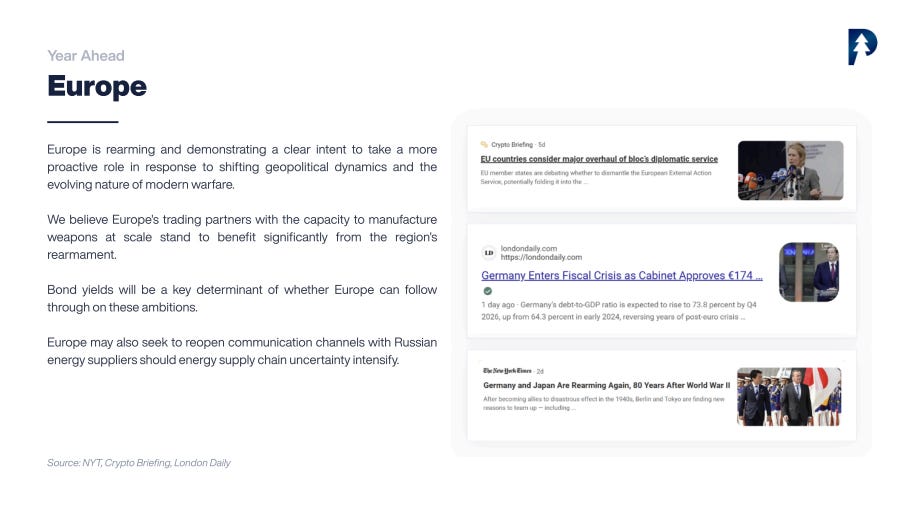
Europe faces an awkward equation. Its governments have committed to the largest rebuilding of their armed forces in decades, which requires borrowing cheaply. At the same time, inflation has pushed its central bank to start raising rates, which makes borrowing expensive. Both cannot comfortably continue. One will have to give, and which one gives will shape European markets for years.
Our discipline here is simple: watch money spent, not money announced. Europe has a long history of announcements outrunning delivery. Factory expansions and defence order books are evidence. Summit declarations are not. So far, the spending looks real but slower than the headlines suggest.
The bond market will decide how far it can go. If borrowing costs rise because Europe is finally investing in itself, that is healthy. If they rise because lenders are growing nervous, that is a different story. Telling those two apart will be the key European judgement of the next two years.
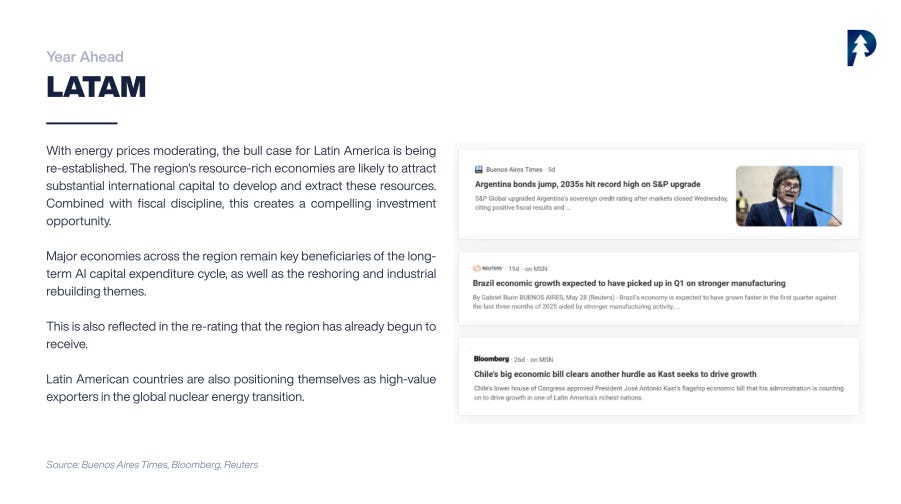
Latin America has always had the resources. What is new is the politics. For the first time in decades, governments across the region are being rewarded by their own voters for financial discipline rather than punished for it. Credit ratings are being upgraded, borrowing costs are falling, and international investors are returning.
Experience makes us careful all the same. This region has hurt as many investors as it has rewarded, and the difference was rarely the resource story, which is usually sound. It was the price paid at entry, the currency, and elections. The regional election calendar over the next eighteen months matters as much as any commodity chart, because it will reveal whether this new discipline is a lasting change or a phase.
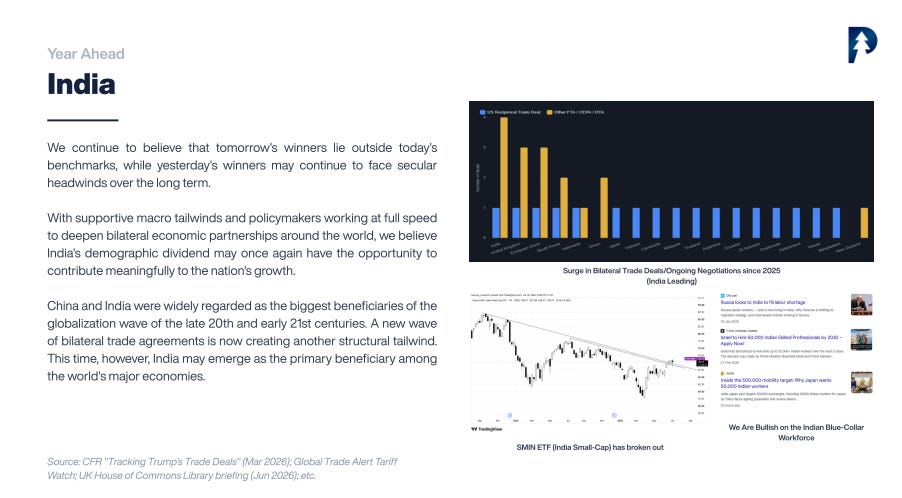
We must be honest about the challenge with India: much of the market now recognizes the country’s long-term growth story, and markets with widely appreciated strengths are rarely cheap. From today’s levels, returns are more likely to come from companies growing their profits than from investors paying ever-higher prices for the same earnings. The correction in many of India’s smaller companies has actually been healthy, bringing valuations closer to reasonable levels. A recovery from a sensible base is far healthier than a rally from an expensive one.
One under-appreciated thread ties into the workforce story on the slide. As Indian workers earn more abroad, remittance inflows continue to grow. Those inflows help support the rupee, and a steadier currency can improve returns for foreign investors by reducing currency risk. It is slow and unglamorous, but it compounds over time.
The risks are the familiar ones. India imports much of its crude oil in a world where energy markets remain uncertain, and new trade agreements bring obligations as well as opportunities.
Until Next Month
Markets rarely move in isolation. Monetary policy, geopolitics, demographics, trade, and liquidity increasingly interact to shape long-term investment outcomes.
At PineTree Macro, our objective is to study these structural developments early and position portfolios around long-duration themes rather than short-term market noise.
We hope this edition of Canopy provides a useful framework for thinking about the opportunities and risks that may define the years ahead.
Read the Full Presentation
The complete July 2026 edition of PineTree Macro Canopy is available on our website: https://pinetreemacro.com/pinetree-macro-canopy-july-2026
Disclaimer
This publication has been prepared by PineTree Macro Pvt Ltd (”PineTree”) for informational and educational purposes only and accompanies the PineTree Macro Canopy - July 2026 presentation published on 14 July 2026. It should be read together with the disclaimer contained in that presentation.
Nothing herein constitutes an offer, solicitation, or recommendation to buy or sell any securities or investment products, nor should it be construed as investment, legal, or tax advice. While PineTree believes the information to be reliable, no representation or warranty is made as to its accuracy or completeness, and the views expressed are subject to change without notice.
All investments involve risk, including the possible loss of principal. Past performance is not indicative of future results. Readers should conduct their own due diligence and seek independent professional advice before making any investment decisions.