I. What is AI at its core?
Strip away the hype and what you have is a multi-model, large language machine. These systems use billions of parameters to find statistical best-fits across enormous datasets. This is not a dismissal; it is a clarification. Understanding what something is, precisely, is the precondition for thinking clearly about where it goes.
Every AI system rests on four pillars:
1. Algorithm — The architecture and training methodology. Firms like Anthropic, OpenAI, and xAI compete here. The design choices determine how efficiently a model learns.
2. Compute — The raw hardware. GPUs (dominated by NVIDIA) and large data centers (Microsoft Azure, AWS, Google Cloud, Oracle) provide the muscle to train and serve models at scale.
3. Data — Text, images, audio, and video scraped from the internet and licensed sources. This is the clay from which intelligence is modelled.
4. Human Feedback — The ongoing effort to rate outputs, flag errors, and guide model behaviour through techniques like Reinforcement Learning from Human Feedback (RLHF). This is the overlooked pillar, and, as I will argue, potentially the most fragile.
II. The Scaling Argument
Assume a decade of uninterrupted progress. Better algorithms from Anthropic’s researchers, better chips from NVIDIA. Would that mechanically translate into better AI?
For a while, yes. Better algorithms mean models learn more efficiently from the same resource base, doing more with less. Better compute means larger models, longer training runs, faster inference. This is the story of the last decade.
But Scaling laws (the idea that simply throwing more compute at better algorithms keeps producing proportional gains) are now broadly understood to exhibit diminishing returns meaning you can’t keep throwing more compute at scale and expect results perpetually. The easy gains are already taken. Each new generation of improvement costs exponentially more to achieve. This is an observed empirical trend that has been independently noted by researchers across the field.
We cannot assume that hardware advancement alone will carry AI capability forward indefinitely.
III. Model Collapse and the Data Wall
Another structural problem is what AI researchers call model collapse, what I think of as the photocopying effect.
Human-generated data is finite. The internet has already been substantially consumed by current model generations. If AI begins to generate the majority of new textual content on the internet, a trajectory we are already on then training future models on that content means training on recycled signal. The information pool is not expanding. It is being circulated.
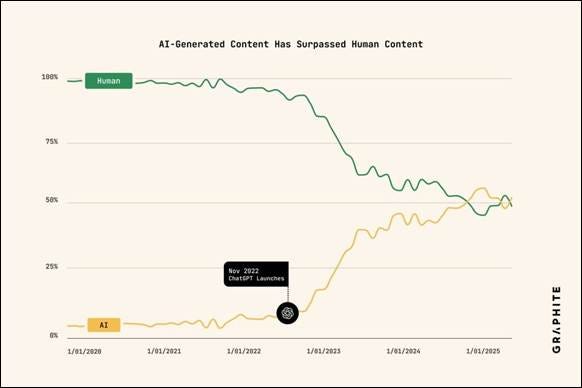
Genuine human insight, novel experience, discovery, and original expression are what historically expanded the knowledge frontier. Every great leap in AI capability was a leap built on top of centuries of authentic human intellectual output. If that raw material stops being produced in sufficient volume and quality, the data pipeline degrades.
IV. The Feedback Ceiling
Studies have begun to document that individuals who rely heavily on AI tools show measurable declines in independent cognitive performance recall, reasoning depth, and critical synthesis. If this trend holds at scale over a decade, what does it mean for the fourth pillar?
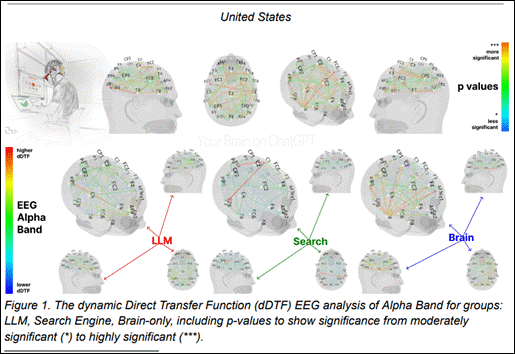
RLHF depends on humans providing good feedback. The model is only as good as the quality of judgment brought to bear on it. In the very long run, a degraded evaluator could produce degraded training signal. The improvement loop could slow, then stagnate, and then potentially reverse.
V. Token-nomics and the Coming Market Structure
On the commercial side, the current subscription model appears unsustainable. Allowing users to consume compute worth thousands of dollars for a flat monthly fee does not represent a viable long-term pricing equilibrium for model providers. A shift toward token-based billing, in my view, is inevitable.

The consequence is clear. Retail users who cannot absorb token-level costs will progressively exit or downscale. The addressable user base of premium AI narrows toward large enterprises with the cashflow to fund intensive inference at volume. If retail users are pushed out, it will eventually start reflecting in future earnings guidance, something that is already visible today

There is a separate structural problem in AI agents that has not yet received sufficient attention. An AI agent recalling context from two- or three-years prior must spend significant compute to do so unlike a human knowledge worker, who carries that memory at zero marginal cost. As agent workloads scale, the economics of long-range context retrieval become a meaningful drag. This is not a temporary engineering limitation; it is a fundamental property of how these systems handle state at this point in time.
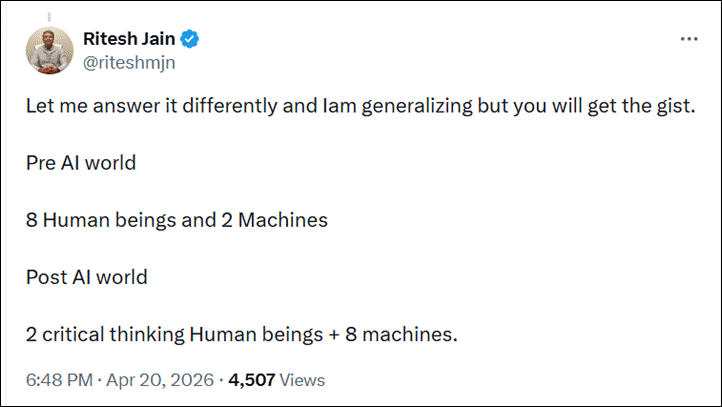
This is exactly why I believe AI agents will replace white-collar jobs that do not demand critical thinking and are based around the premise of repetition.
Deliberate model obsolescence is another risk that warrants explicit attention. Providers have a clear commercial incentive to degrade the performance of older models in ways that nudge users toward newer, higher-priced tiers. In effect, AI companies could adopt a strategy similar to the iPhone playbook.
VI. On Markets
These structural observations map onto investment implications:
1. OpenAI has no durable moat and no clearly defined target segment. It is the most exposed to competitive erosion, I say this because Google and its AI products are well embedded into an android consumer products ecosystem (even Apple has partnered with Alphabet for Siri) while Anthropic is shining out to become the leading enterprise AI architecture provider. Its collapse when it comes, will create second-order damage for any investor, partner, or counterparty with receivables or capital exposure.
2. Anthropic (Claude) appears well positioned to serve large corporates with strong internal cash flows. Token-based pricing structurally favors providers with deep enterprise distribution. The key caveat, however, is that even large firms such as Uber and Microsoft are beginning to demonstrate greater cost discipline around AI spend, which may ultimately weigh on valuation multiples.

3. Grok and Meta AI remain product add-ons. They benefit from platform distribution; it will become increasingly difficult to project economic value gains that will justify the capex.
4. Apple appears to be taking a patient approach. If segments of the AI infrastructure stack were to face overcapacity and pricing pressure, there could be opportunities for well-capitalized players to acquire assets at discounted valuations, similar in spirit to how buyers capitalized on excess capacity following the dot-com bubble.
5. Data centre energy costs are a risk. Jurisdictions are increasingly resistant to hosting large data centre infrastructure. Utilities understand their pricing power. The cost base for AI inference is not static.
VII. The Jevons Paradox and Chess
The Jevons Paradox states that when technological progress increases the efficiency with which a resource is used, total consumption of that resource tends to rise rather than fall. Applied to AI: cheaper, more capable intelligence tools will not reduce the aggregate demand for intelligence-intensive work.
My variant of this thesis is that the paradox will manifest as a salary premium for a smaller pool of elite knowledge workers. A sharper bifurcation. The best will earn more. The median will face displacement.
The closest historical analogy I can find is what computers did to chess. When computational engines became widely available as training tools, the standard of human play did not decline it exploded. A generation of players who trained with engines achieved capabilities that prior generations could not have imagined. The tool did not replace the player. It created a new class of player who used the tool to transcend previous limits.
AI will likely do the same for white-collar knowledge work but only for those who will not outsource their critical thinking to AI.
Closing Thoughts
The bull case for AI is not dead, but it is conditional. It requires research breakthroughs that address the scaling ceiling, the data wall, and the feedback degradation problem. It requires a commercial restructuring that produces sustainable unit economics, and it requires users who treat these tools as force multipliers for their own cognition, not substitutes for it.